

Research ArticleOpen Access, Volume 3 Issue 2
The co-occurrence of non-suicidal self-injury and suicide attempts in a non-clinical sample of South African adolescents
Collings SJ*; Valjee SR
School of Psychology, University of KwaZulu-Natal, Howard College Campus, Republic of South Africa.
*Corresponding author: Steven John Collings
School of Psychology, University of KwaZulu-Natal, Howard College Campus, Durban 4041, Republic of South Africa.
Email: collings@ukzn.ac.za
Received : Sep 04, 2025 Accepted : Sep 23, 2025 Published : Sep 30, 2025
Epidemiology & Public Health - www.jpublichealth.org
Copyright: Collings SJ © All rights are reserved
Citation: Collings SJ, Valjee SR. The co-occurrence of non-suicidal self-injury and suicide attempts in a non-clinical sample of South African adolescents. Epidemiol Public Health. 2025; 3(2): 1080.
Abstract
Background: A co-occurrence of Non-Suicidal Self-Injury (NSSI) and Suicide Attempts (SA) has been documented in the literature, with such co-occurrence tending to be associated with higher psychological and behavioural problems. However, to date no such study has been conducted in Africa. This study sought to determine the prevalence of, and risk factors for, the co-occurrence of NSSI and SA in a non-clinical sample of South African adolescents.
Materials and methods: A cross-sectional study was conducted among 636 high school students (age: 12-18 years; Mage =15.3) attending a school in the city of Durban, KwaZulu-Natal, South Africa. Data were collected using a structured questionnaire, with NSSI and SA being assessed using items adapted from the Self-Harm subscale of the Risk-Taking and Self-Harm Inventory for Adolescents, with various validated measures being used to assess participants’ psychological well-being, and a revised version of the Adverse Child Experience Questionnaire being used to assess childhood adverse experiences. Data analyses were conducted using descriptive statistics, with risk factors for the co-occurrence of NSSI and SA being assessed using a multinomial logistic regression analysis.
Results: Reported prevalence rates for: past 12-month NSSI were 26.7%, past 12-month SA were 16.4%, with the co-occurrence of these conditions during the past 12-months being 9.0%; with risk factors for co-occurrence being an older age, female sex, self-identifying as Black African, emotion dysregulation, suicidal ideation, depression, and peer exclusion.
Conclusion: Comparatively high rates for the co-occurrence of non-suicidal behaviour and suicide attempts reported in this study suggests the need for targeted intervention strategies designed to address identified risk factors. There is also a clear need for further research among adolescents living in other low- to middle-income African countries in order to assess the generalizability of study findings.
Keywords: Co-occurrence; Non-suicidal self-injury; NSSI; Suicide attempts; Prevalence; Risk factors; South Africa.
Introduction
Two forms of intentional self-harm – Non-Suicidal Self-Injury (NSSI) and a history of Suicide Attempts (SA) – have been included in the fifth, text revised, edition of the Diagnostic Manual of Mental Disorders (DSM-5-TR) [1] as conditions that may be the focus of clinical attention. Although these forms of self-harm are not mental disorders, they need to be coded in situations where self-harm is the reason for a clinical visit or where self-harm is relevant to the overall assessment or management plan. According to DSM-5-TR, NSSI involves intentional, self-inflicted damage to the surface of the body in the absence of suicidal intent [1]; with prevalence rates for NSSI ranging from 4% to 23% for adults and from 13.9% to 28.6% for non-clinical samples of adolescents [2,3]. The fact that NSSI has been found to be associated with a variety of mental disorders (including: anxiety disorders, depressive disorders, and eating disorders) [4-8], and has been found to constitute a risk factor for suicide attempts [9], suggests that NSSI constitutes an important clinical and public health concern. In addition to comorbidity with mental disorders, risk factors for NSSI have been found to include: female gender, emotion dysregulation, ethnic social minority status, sexual and gender social minority status, and/or exposure to adverse childhood experiences (including child abuse) prior to the age of 18 years [10,11]. Suicide attempts involve intentional self-injurious behaviours that are motivated by at least some intent to die. The overall global prevalence rate for SA has been estimated to be 9.2% [12], with comparative estimates for African countries being 9.9% [13]. Risk factors for SA have been found to include: female gender [14], residence in a low to middle-income country [13], a previous history of SA [15]. a history of a prior mental disorder (including: mood disorders, impulse-control disorders, anxiety disorders, and/or substance use disorders) [13], a prior history of NSSI behaviours [15], and exposure to adverse childhood experiences (including child maltreatment) [16].
The co-occurrence of NSSI and SA
Despite the fact that NSSI and SA can be clearly distinguished by the presence or absence of suicidal intent, there is emerging evidence that NSSI and SA often co-occur (NSSI+SA), with such co-occurrence leading to more severe psychological and behavioural problems [6,17]. In Ye and colleague’s recent meta-analysis of 37 studies [17] the overall prevalence rate for NSSI+SA was 9.1%, with incidence rate for occurrence being lower in the general population (6%) than among psychiatric patients (26%). At a broader level the analysis found marked differences in the prevalence of co-occurrence for different continents (5% in Asia, 8% in Europe, and 12% in North America) and for developed (11%) versus developing (4%) countries. Although Ye and colleagues’ [17] findings are informative, their review has a number of limitations. First, with the notable exception of one study that was published in Australia, studies reviewed were all published in the northern hemisphere and therefore may not provide an accurate estimate of NSSI+SA in South Africa or in most southern hemisphere countries.
The present study
The extant literature on the co-occurrence of NSSI and SA is extremely sparse, and has largely been restricted to high income countries in the northern hemisphere. Although available evidence suggests that there are likely to be inter-continental variations in the prevalence of NSSI+SA, it was not possible to identify any studies that have been conducted in Africa. In order to address these gaps, this study explored the prevalence of NSSI+SA in a non-clinical sample of South African adolescents; with the focus on adolescents being informed by the fact that: (a) the peak incidence for NSSI has been found to occur at 14-15 years [2,9,18,19] with (b) annual prevalence rates for suicide attempts among South African adolescents having been found to be significantly higher than comparative rates for high income countries [20].
Methodology
Participants
The target sample for this cross-sectional study was all 734 students attending an urban co-educational public high school in the Durban Metropolitan region (South Africa); with 636 participants returning completed questionnaires. An examination of school records indicated that participants did not differ significantly from non-participants in terms of age, ethnicity, and gender. Most participants were male, with participant ages ranging from 12-18 years (Mage=15.4, SD=1.5 years). The percentage of participants by grade was: Grade 8(21.4%), Grade 9(17.8%), Grade 10(25.7%), Grade 11(22.4%), and Grade 12(12.7%). Participants self-reported ethnicity was: Black African (96.0%), blended ethnicity (1.9%), Caucasian (1.5%), or Asian (0.6%).
Procedure
Questionnaires were administered to whole classes of assenting students during Life Orientation classes, with the researcher and Life Orientation teacher being present to assist with any queries participants may have and to monitor participants for possible distress. In cases where distress was noted, participants were provided with an option of discontinuing their participation.
Measures
Independent variables:
Demographic variables. Consistent with identified risk factors for NSSI and/or SA, age, gender, and ethnicity were considered as potential predictors of NSSI or SA behaviours. For purposes of analysis binary coding was employed (0,1), with a value of 1 being given to participants who self-identified as female or Black African and who were older (15-18 years).
Emotion dysregulation was assessed using the 6-item Alteration in Regulation and Affect (ARA) subscale of the self-report version of the Structed Interview for Disorders of Extreme Stress Scale (SIDES-SR) [21] that has previously been used in research on South African adolescents [22]. Items on this scale are scored on a 4-point scale ranging from 1(not at all) to 3 (very much so). Research on the SIDES-SR indicates that the scale has high levels of internal consistency (α=.96) with Cronbach alpha for the ARA scale being .82 [21]. In this study Cronbach alpha for the ARA scale was .80.
Social disconnectedness was assessed using two items from the SIDES-SR (“I have felt separate from and very different from other people” and “I have avoided being in relationships with other people”), with social disconnectedness being deemed to be present if participants obtained a score of at least 2 (quite a lot) for at least one of these two items.
Suicide ideation was assessed using one item from the SIDES-SR (“I have thought about killing myself in the past 12-months”), with suicide ideation being deemed to be present if participants obtained a score of at least 2 (quite a lot) for this item.
Depression was assessed using the Patient Health Questionnaire (PHQ-9) [23] that has previously been used in studies involving South African adolescents [24]. The PHQ-9 contains 9-items that are scored on a 4-point scale ranging from 0 (not at all) to 4 (nearly every day), with a total score of 15 or higher representing clinically significant levels of depression. The scale has been found to have high levels of internal consistency (α = .86 to 89 across studies), with Cronbach alpha in this study being .86.
Anxiety was assessed using the 7-item Generalised Anxiety Disorder Scale (GAD-7) [25] that has previously been used in studies of South African adolescents [26]. The GAD-7 uses the same scoring structure as the PHQ-9, with a score of 10 or higher representing clinically significant levels of anxiety. Cronbach alpha for the scale has been found to be .92 (alpha in this study being .90).
Posttraumatic stress symptoms were assessed using the 20-item Posttraumatic Stress Disorder (PTSD) Checklist for DSM-V (PCL-5) [27] that has previously been used in research on young adults in South Africa [28]. Items on the PCL-5 are scored on a 5-point scale ranging from 0 (not at all) to 4 (extremely), with a score of 33 or more representing clinically significant levels of PTSD symptoms [29]. Blevins and colleagues [27] report high levels of convergent and discriminative validity for the scale as well as strong internal consistency (α=0.94). In this study Cronbach alpha was .92.
Exposure to Adverse Childhood Experiences (ACEs) was assessed using a 14-item revised version of the ACEs questionnaire [30]: i.e., the ACE-R questionnaire developed by Finkelhor and colleagues [31]. Each item on the ACE-R was scored using binary coding (0 = absent or 1 = present).
Dependent variables:
NSSI was assessed using an adapted version of the Self-Harm subscale of the Risk-Taking and Self-Harm Inventory for Adolescents [32], that has previously been used in studies of South African adolescents [33]. For purposes of the study NSSI was regarded as being present if NSSI behaviours occurred on at least five days in the past year (alpha = .79 in this study).
Suicide Attempts (SA). The self-harm subscale of the RTSHIA contains a number of additional items that do not involve NSSI [32], with one of these items being “Have you ever tried to kill yourself”. For purposes of this study this item was adapted to read “In the past year have you intentionally tried to kill yourself because you did not want to live any more”. For study purposes SA was regarded as being present if participants reported at least one suicide attempt in the past year.
NSSI+SA. In order to identify the co-occurrence of two conditions it is necessary to ensure that both conditions occurred during the same time period. As such, both NSSI and SA were assessed during the past 12-months.
Data analysis
All analyses were conducted using IBM SPSS 29, with descriptive statistics being conducted using nonparametric procedures (Chi2, correlation coefficients, measures of variability and central tendency) and with risk factors for different types of self-harm behaviours being assessed using a multinomial logistic regression analysis.
Ethics: An institutional ethical clearance certificate was obtained for the research (protocol reference number: HSS/0149/11D). In addition, written gatekeeper permission from the school principal, parental consent, and participant assent were obtained.
Results
The prevalence of NSSI and SA
One hundred and seventy participants (26.7%, SE=.02) reported that they had engaged in NSSI behaviours on at least five days in the past year. The three most frequently reported forms of NSSI were: “cut your skin” (23.3%, SE=.04), “banged your head against a hard surface” (19.7%, SE=.04), and “burned yourself with a hot object” (9.1%, SE=.02). Prevalence rates for NSSI were higher for 15-18-year-olds (40.0%) than for 12-14-year-olds (23.3%), χ21df=8.19, p=.004. However, NNSI prevalence rates did not vary significantly as a function of ethnicity (χ21df=1.29, p=.256), participants’ sex (χ21df=3.77, p=.052), or poverty in the family home (χ21df=1.79, p=.181). The comparative prevalence rate for past-year SA was 16.4% (SE=.02), with 6.4% of participants reporting more than one suicide attempt in the past year. Prevalence rates for SA were higher for females (25,5%) than for males (11.7%) (χ21df =19.85, p=<.001) and higher among participants who reported poverty in the home (26.0%) than among those who did not report poverty in the home (14.6) (χ21df=7.76, p=.005). However, prevalence rates for SA did not vary as a function of either age (χ21df=0.64, p=.424) or ethnicity (χ21df=0.01, p=.966).
NSSI+SA
Fifty-seven participants (9.0%) met the study requirements for the presence of both NSSI and SA. Among the 170 participants who reported past-year NSSI, 57(33.5%) also reported past-year SA, and among the 104 participants who reported past-year SA, 57(54.8%) also reported past-year NSSI (Figure 1).
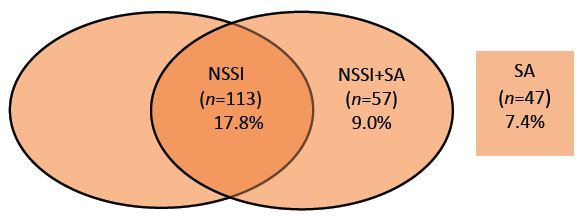
Prevalence rates for NSSI+SA were higher for females (15.7%) than for males (5.5%) (χ21df=18.42, p=<.001) and for participants who reported poverty in the home (14.6%) than for those who did not report poverty in the home (8.0%) (χ21df=4.38, p=.036) However, prevalence rates for NSSI+SA did not vary as a function of either age (χ21df=0.64, p=.424) or ethnicity (χ21df=0.01, p=.966). With regard to the methodological diversity of self-harm behaviours, participants who reported NSSI+SA were more likely to engage in NSSI behaviours on 12 or more days in the past year (χ21df=79.95, p<.001) and were more likely to report two or more past-year suicide attempts (χ21df=12.04, p<.001).
Risk factors for NSSI, SA, and NSSI+SA
For purposes of analysis, participants were divided into four mutually exclusive groups: (a) a control, who did not report either NSSI or SA (n=419, 65.9%) (b) those who reported NSSI only (n=113, 17.8%); (c) those who reported SA only (n=47, 7.4%), and (d) those who reported both NSSI+SA (n=57, 9.0%) (Table 1). A multinomial logistic regression analysis was then conducted (with the control group as the reference category) in order to identify risk factors associated with different types of exposure to self-harming behaviours. The regression model accounted for a significant proportion of the variance (Nagelkerke R2=.369, p<.001). From (Table 1) it is evident that significant risk factors for the NSSI-only category were: an older age, physical abuse, sexual abuse, parental separation, and peer isolation/exclusion. Significant risk factors for the SA-only category were: suicidal ideation and physical neglect. Finally, risk factors for the co-occurrence of NSSI and SA were: an older age, female sex, self-identifying as Black African, emotion dysregulation, suicidal ideation, depression, and peer exclusion/isolation.
Table 1: Multinomial logistic regression analysis of risk factors for self-harm behaviours.
| Risk factors for self-harm behaviours | ||||||
|---|---|---|---|---|---|---|
| (noself-harm behaviours as the reference category) | ||||||
| NSSI only | SAonly | NSSI+SA | ||||
| (n = 113, 17.8%) | (n =47, 7.4%) | (n =57, 9.0%) | ||||
| Predictors | OR (95% CI) | p | OR (95% CI) | p | OR (95% CI) | p |
| Older age(15-18 years) | 2.01 (1.25-3.23) | 0.004 | 1.21 (0.58-2.53) | 0.61 | 3.65 (1.72-7.69) | <.001 |
| Female | 0.99 (0.60-1.65) | 0.974 | 1.22 (0.60.2.49) | 0.582 | 2.12 (1.01-4.46) | 0.046 |
| Black African | 0.30 (0.04-2.36) | 0.254 | 0.85 (0.09-7.25) | 0.881 | 6.06 (1.24-29.41) | 0.026 |
| Emotion dysregulation | 1.25 (0.72-2.15) | 0.426 | 1.73 (0.82-3.64) | 0.15 | 3.62 (1.69-7.75) | <.001 |
| Social disconnectedness | 1.58 (0.96-2.58) | 0.071 | 0.65 (0.33-1.31) | 0.231 | 1.41 (0.62-3.23) | 0.417 |
| Suicidal ideation | 1.20 (0.70-2.07) | 0.509 | 5.29 (2.58-10.87) | <.001 | 8.55 (3.80-19.23) | <.001 |
| Depression | 1.20 (0.66-2.21) | 0.55 | 1.90 (0.86-4.20) | 0.112 | 2.68 (1.27-5.68) | 0.01 |
| Anxiety | 2.32 (0.69-7.75) | 0.172 | 0.50 (0.05-4.88) | 0.552 | 2.19 (0.51-9.43) | 0.291 |
| PTSD | 0.79 (0.47-1.32) | 0.366 | 1.19 (0.58-2.48) | 0.637 | 0.94 (0.41-2.15) | 0.887 |
| Emotional abuse | 0.59 (0.28-1.23) | 0.159 | 0.83 (0.28-2.48) | 0.739 | 0.40 (0.11-1.43) | 0.157 |
| Physical abuse | 1.80 (1.11-2.91) | 0.018 | 0.98 (0.48-2.00) | 0.946 | 1.68 (0.77-3.66) | 0.197 |
| Sexual abuse | 1.63 (1.02-2.60) | 0.041 | 1.38 (0.69-2.78) | 0.363 | 1.69 (0.83-3.42) | 0.148 |
| Emotional neglect | 1.91 (0.76-4.78) | 0.168 | 1.55 (0.42-5.85) | 0.517 | 1.84 (0.43-7.87) | 0.411 |
| Physical neglect | 1.68 (0.88-3.19) | 0.115 | 3.25 (1.38-7.63) | 0.007 | 1.94 (0.78-4.85) | 0.155 |
| Parental separation | 1.93 (1.04-3.58) | 0.037 | 1.08 (0.41-2.82) | 0.878 | 0.90 (0.33-2.42) | 0.831 |
| Mother treated violently | 0.98 (0.58-1.64) | 0.929 | 0.60 (0.27-1.36) | 0.226 | 1.05 (0.48-2.27) | 0.905 |
| Home substance abuse | 0.96 (0.25-3.70) | 0.957 | 1.05 (0.18-6.33) | 0.954 | 0.81 (0.09-6.94) | 0.85 |
| Family mentalillness | 1.05 (0.66-1.65) | 0.844 | 0.98 (0.50-1.92) | 0.951 | 1.46 (0.71-3.00) | 0.308 |
| Family memberin prison | 1.67 (0.49-1.51) | 0.599 | 0.83 (0.35-1.97) | 0.675 | 1.88 (0.82-4.33) | 0.136 |
| Poverty in the home | 0.87 (0.44-1.70) | 0.683 | 1.24 (0.54-2.86) | 0.607 | 1.39 (058-3.22) | 0.466 |
| Peer victimisation | 0.85 (0.45-1.60) | 0.616 | 0.84 (0.34-2.11) | 0.717 | 1.29 (0.54-3.10) | 0.572 |
| Peer exclusion/isolation | 2.04 (1.05-3.98) | 0.036 | 2.00 (0.77-5.24) | 0.157 | 3.40 (1.37-8.47) | 0.008 |
| Community violence | 1.45 (0.80-2.62) | 0.221 | 1.09 (0.40-2.94) | 0.87 | 0.80 (0.28-2.31) | 0.68 |
| Nagelkerke (PseudoR2) = .369 | ||||||
NSSI: Non-Suicidal Self-Injury; SA: Suicide Attempts; NSSI+SA: The Co-Occurrence of NSSA and SA. Significant findings are highlighted in bold.
Discussion
The primary aim of this study was to explore the prevalence of NSSI and SA, and to establish the prevalence of, and risk factors for, NSSI+SA in a non-clinical sample of South African adolescents.
The prevalence of self-harm
The obtained prevalence rate for past 12 month NSSI (26.7%) is slightly higher than comparative global prevalence estimates for NSSI (23.2%) among non-clinical samples of adolescents [3], and is markedly higher than aggregated prevalence rates (19.6%) for past 12 month NSSI reported for adolescents living in low- and middle-income countries [34]. Similarly, the obtained prevalence rate obtained for SA (16.4%) is notably higher than the 12-month global prevalence rate of 5.2% reported for adolescents and youth [35], but is similar to the mean 12-month prevalence rate for SA of 17.2% reported in studies of adolescents in 40 low- to middle-income countries [36]. Obtained prevalence rates for NSSI+SA in this study (9.0%) are higher than comparative global estimates for NSSI+SA among adolescents (5%) and higher than estimates for developing countries (4%) [17]. Thus, study findings provide little support for the view that prevalence rates for deliberate self-harm are likely to be lower among adolescents living in developing countries [17], suggesting rather that the risk for engaging in deliberate self-harm behaviours (including NSSI+SA) among South African adolescents may be comparatively high.
Risk factors for engaging in self-harm behaviours
Risk factors for deliberate self-harm behaviours considered in this study increased the likelihood of: (a) NSSI-only outcomes by between 1.63 (sexual abuse) and 2.04 (peer exclusion). (b) SA-only outcomes by between 3.25 (physical neglect) and 5.29 (suicidal ideation), and (c) NSSI+SA outcomes by between 2.12 (female sex) and 6.06 (Black African).
At a general level, the analysis of risk factors for self-harm behaviours produced some noteworthy findings. First, from (Table 1) it is evident that there was no overlap in the risk factors that uniquely predicted NSSI and SA, suggesting that there may be different etiological pathways leading to these two types of self-harm outcomes. Second, with regard to the methodological diversity of self-harm behaviours, participants who reported NSSI+SA were more likely to engage in NSSI behaviours on 12 or more days in the past year and were significantly more likely to report two or more past-year suicide attempts, with an increased frequency of self-harm behaviours being likely to be associated with increased threats to the individual’s wellbeing [6]. And third, although there were significant univariate associations between poverty in the home and both SA and NSI+SA outcomes, these associations fell away in multivariate analyses. This pattern of findings is: (a) consistent with findings from high-income countries which have found that family poverty is associated with adverse mental health outcomes [31], as well as with South African findings that poverty in the family home is associated with an increased risk of exposure to multiple adverse childhood experiences [37,38], and (b) is congruent with the view that the association between poverty and adverse mental health outcomes is likely to be mediated by cumulative adverse experiences that children living in impoverished homes are more likely to be exposed to [39,40]
Noteworthy findings also emerged in relation to the association between emotion dysregulation and NSSI+SA Although it is generally acknowledged that emotional dysregulation constitutes a proximal risk factor for NSSI [17], findings from this study suggest that this association may be stronger in situations where there is a co-occurrence of NSSI and suicide attempts, with the likelihood of NSSI+SA outcomes in this study being 3.6 times more likely among participants who reported high levels of emotion dysregulation.
Finally, the finding that participants who self-identified as Black African were six times more likely to report NSSI+SA outcomes is a novel finding that is worthy of further consideration. One possible reason for this finding could relate to continuing historical trauma in terms of which many of the individuals who were most severely disadvantaged under the Apartheid regime (i.e. Black Africans) continue to experience socially mediated forms of poverty and discrimination that have been found to be associated with greater exposure to risk factors for self-harm behaviours [41]. Findings from this study do not, however, provide direct support for such a hypothesis, with further research being indicated in order to further explicate this association.
Implications of study findings
Available literature on NSSI+SA has been characterized by marked heterogeneity in relation to the ways in which key constructs are defined [3,17]. As a result, conclusions relating to comparative prevalence rates for, and the dynamics of, NSSI, SA, and NSSI+SA need to be made with due caution as most previous studies have relied on lifetime (as opposed to past-year) exposure to both NSSI and SA [17]. As such, meaningful comparisons of prevalence rates for NSSI, SA and NSSI+SA would appear to require the development of common operational definitions of key constructs – possibly along the lines of the operational definitions proposed in the fifth edition of the DSM [1] – which would provide a more rational and systematic basis for identifying regional and global trends in relation to deliberate self-harm behaviours.
Not with standing definitional diversity, the high prevalence rates obtained for NSSI+SA in this study suggest the need for urgent attention and effective interventions deigned to target not only risk factors identified in this study but also risk factors for NSSI+SA identified in previous studies [6,17]. Contemporary perspectives on the efficacy of such intervention efforts would suggest that interventions are likely to be most effective if they are multisystemic in nature and are designed to address both risk factors and salutary influences on the wellbeing of adolescents [42,43].
Study findings would also appear to have a number of implications for future research. First, study findings suggest that there is a need for research designed to more systematically explore possible differences in etiological pathways that may be associated with different types of deliberate self-harm behaviours. Second, there would appear to be a need for further research that employs path or mediation analyses, in order to further clarify the complex interactions between risk factors and NSSI+SA outcomes. And third, given high rates of NSSI+SA reported by participants in this study, there would appear to be a need for further studies conducted, not only in South Africa, but also in other African countries, in order to provide a truly global perspective on the prevalence and dynamics of self-harming behaviours in developing countries.
Strengths and limitations
To our knowledge this is the first study to examine the prevalence and risk factors for NSSI+SA in Africa. The study is, however, characterised by a number of limitations. First, the use of a cross-sectional design limits the confidence with which causal inferences can be made and second the use of a convenience sample of adolescents may limit the generalisability of study findings. Future research would benefit from the use of prospective designs and the use of larger samples that are more representative of the South African population.
Declarations
Acknowledgements: The authors would like to thank the principal, staff, and students at the participating school for their cooperation and assistance.
Author contributions: Study design/conceptualization (S.R.V. and S.J.C.), data collection (S.R.V.), data analysis (S.J.C.), manuscript writing, editing and approval (S.R.V. and S.J.C.).
Funding: The authors declare that no funding was received for this research.
Conflict of interest: The authors declare no competing interests.
Data availability: Study data are available from the corresponding author on reasonable request
References
- American Psychiatric Association. Diagnostic and Statistical Manual of Mental Disorders. 5th text revised edn. Arlington: American Psychiatric Publishing. 2022.
- Cipriano A, Cella S, Cotrufo P. Non-suicidal self-injury: a systematic review. Front Psychol. 2017; 8: 1946.
- Xiao Q, Song X, Huang L, Hou D, Huang X. Global prevalence and characteristics of non-suicidal self-injury between 2010 and 2021 among a non-clinical sample of adolescents: a meta-analysis. Front Psychiatry. 2022; 13: 912441.
- Gratz KL, Tull MT. Exploring the relationship between posttraumatic stress disorder and deliberate self-harm: the moderating roles of borderline and avoidant personality disorders. Psychiat Res. 2012; 119: 19-23.
- Kaess M, Parzer P, Mattern M, Plener PL, Bifulco A, Resch F, et al. Adverse childhood experiences and their impact on frequency, severity, and the individual function of nonsuicidal self-injury in youth. Psychiat Res. 2013; 206: 265-272.
- Kiekens G, Hasking P, Clae L, Mortier P, Auerbach RP, Boyes M, et al. The DSM-5 nonsuicidal self-injury disorder among incoming college students: prevalence and associations with 12-month mental disorders and suicidal thoughts and behaviors. Depress Anxiety. 2018; 35: 629-637.
- Rahman F, Webb RT, Wittkowski A. Risk factors for self-harm repetition in adolescents: a systematic review. Clin Psychol Rev. 2021; 88: 102048.
- Sohn MN, Dimitropoulos G, Ramirez A, McPherson C, Anderson A, Munir A, et al. Non-suicidal self-injury, suicidal thoughts and behaviors in individuals with an eating disorder relative to healthy and psychiatric controls: a systematic review and meta-analysis. Int J Eat Disord. 2023; 56: 501–515.
- da Silva Bandeira BE, dos Santos Júnior A, Dalgalarrondo P, de Azevedo RCS, Celeri EHVR. Nonsuicidal self-injury in undergraduate students: a cross-sectional study and association with suicidal behaviour. Psychiat Res. 2022; 318: 114917.
- Kothadia RJ, Joshi KG, Frierson RL. Risk factors for nonsuicidal self-injury: a review of the evidence. Cur Psychiatry Rev. 2022; 21: 15-25.
- Wang YJ, Li X, Ng CH, Xu DW, Hu S, Yuan TF. Risk factors for non-suicidal self-injury (NSSI) in adolescents: a meta-analysis. EClinicalMedicine. 2022; 46: 101350.
- Nock MK, Borges G, Bromet EJ, Alonso J, Angermeyer M, Beautrais A, et al. Cross-national prevalence and risk factors for suicidal ideation, plans and attempts. Brit J Psychiat. 2008; 192: 98-105.
- Babajani F, Salari N, Hosseinian-Far A, Abdoli N, Mosafer H, Heidarian P, et al. Prevalence of suicide attempts across the African continent: a systematic review and meta-analysis. Asian J Psychiatr. 2024; 91: 103878.
- Cai Z, Canetto SS, Chang Q, Yip PSF. Women’s suicide in low-, middle-, and high-income countries: do laws discriminating against women matter? Soc Sci Med. 2021; 282: 14035.
- Bayliss LT, Christensen S, Lamont-Mills A, du Plessis C. Suicide capability within the ideation-to-action framework: a systematic scoping review. PLoS ONE. 2022; 17: e0276070.
- Thompson MP, Kingree JB, Lamis D. Associations of adverse childhood experiences and suicidal behaviors in adulthood in a U.S. nationally representative sample. Child Care Health Dev. 2019; 45: 121–128.
- Ye Z, Xiong F, Li W. A meta-analysis of co-occurrence of non-suicidal self-injury and suicide attempt: implications for clinical intervention and future diagnosis. Front Psychiatry. 2022; 13: 976217.
- Gandhi A, Luyckx K, Baetens I, Kiekens G, Sleuwaegen E, Berens A, et al. Age of onset of NSSI in Dutch-speaking adolescents and emerging adults: an event history analysis of pooled data. Compr Psychiatry. 2018; 80: 170-178.
- Plener P, Schumacher TS, Munz LM, Groschwitz RC. The longitudinal course of non-suicidal self-injury and deliberate self-harm: a systematic review of the literature. Bord Personal Disord Emot Dysregul. 2015; 2: 2.
- Centers for Disease Control and Prevention. Youth risk behavior survey data. National Center for Chronic Disease Prevention and Health Promotion. 2023. Available from: www.cdc.gov/yrbs.
- Pelcovitz D, van der Kolk B, Roth S, Mandel F, Kaplan S, Resick P. Development of a criteria set and a structured interview for disorders of extreme stress (SIDES). J Trauma Stress. 1997; 10: 3-16.
- Penning SL. Traumatic Re-Enactment of Childhood and Adolescent Trauma: A Complex Developmental Trauma Perspective in a Non-Clinical Sample of South African School-Going Adolescents. 2015. Available from: http://hdl.handle.net/10413/14619.
- Kroenke K, Spitzer RL, Williams JB. The PHQ-9: validity of a brief depression severity measure. J Gen Intern Med. 2001; 16: 606-613.
- Baron EC, Davies T, Lund C. Validation of the 10-item Centre for Epidemiological Studies Depression Scale (CES-D-10) in Zulu, Xhosa and Afrikaans populations in South Africa. BMC Psychiatry. 2017; 17: 6.
- Spitzer RL, Kroenke K, Williams JBW, Löwe B. A brief measure for assessing generalized anxiety disorder: the GAD-7. Arch Intern Med. 2006; 166: 1092-1097.
- Rochat TJ, Houle B, Stein A, Mitchell J, Bland RM. Maternal alcohol use and children’s emotional and cognitive outcomes in rural South Africa. S Afr Med J. 2019; 109: 526-534.
- Blevins CA, Weathers FW, Davis MT, Witte TK, Domino JL. The Posttraumatic Stress Disorder Checklist for DSM-5 (PCL-5): development and initial psychometric evaluation. J Trauma Stress. 2015; 28: 489–498.
- Pretorius TB, Padmanabhanunni A. Anxiety in brief: assessment of the Five-Item Trait Scale of the State-Trait Anxiety Inventory in South Africa. Int J Environ Res Public Health. 2023; 20: 5697.
- Weathers FW, Litz BT, Keane TM, Palmieri PA, Marx BP, Schnurr PP. The PTSD Checklist for DSM-5 (PCL-5). National Center for PTSD. 2013. Available from: https://www.ptsd.va.gov/professional/assessment/documents/using-PCL5.pdf.
- Felitti VJ, Anda RF, Nordenberg D, Williamson DF, Spitz AM, Edwards V, et al. Relationship of childhood abuse and household dysfunction to many of the leading causes of death in adults: the Adverse Childhood Experiences (ACE) Study. Am J Prev Med. 1998; 14: 245-258.
- Finkelhor D, Shattuck A, Turner H, Hamby SA. Revised inventory of adverse childhood experiences. Child Abuse Negl. 2015; 48: 13-21.
- Vrouva I, Fonagy P, Fearon PRM, Roussow T. The risk-taking and self-harm inventory for adolescents: development and psychometric evaluation. Psychol Assess. 2010; 22: 852-865.
- Oduaran C, Agberotimi SF. Moderating effect of personality traits on the relationship between risk-taking behaviour and self-injury among first-year university students. Adv Ment Health. 2021; 19: 247-259.
- Aggarwal S, Patton G, Reavley N, Sreenivasan SA, Berk M. Youth self-harm in low- and middle-income countries: systematic review of the risk and protective factors. Int J Soc Psychiatry. 2017; 63: 359-375.
- Van Meter AR, Knowles EA, Mintz EH. Systematic review and meta-analysis: international prevalence of suicidal ideation and attempt in youth. J Am Acad Child Adolesc Psychiatry. 2023; 62: 973–986.
- Liu RT, Sheehan AE, Walsh RFL, Sanzari CM, Cheek SM, Hernandez EM. Prevalence and correlates of non-suicidal self-injury among lesbian, gay, bisexual, and transgender individuals: a systematic review and meta-analysis. Clin Psychol Rev. 2019; 74: 101783.
- Manyema M, Richter LM. Adverse childhood experiences: prevalence and associated factors among South African young adults. Heliyon. 2019; 5: e03003.
- Snider L, Dawes A. Psychosocial vulnerability and resilience measures for national-level monitoring of orphans and other vulnerable children: recommendations for revision of the UNICEF psychological indicator. Cape Town; UNICEF: 2006.
- Evans GW, De France K. Childhood poverty and psychological well-being: the mediating role of cumulative risk exposure. Dev Psychopathol. 2022; 34: 911-921.
- Manyema M, Norris SA, Richter LM. Stress begets stress: the association of adverse childhood experiences with psychological distress in the presence of adult life stress. BMC Public Health. 2018; 18: 835.
- Adonis CK. Bearing witness to suffering: a reflection on the personal impact of conducting research with children and grandchildren of victims of Apartheid-era gross human rights violations in South Africa. Soc Epistemol. 2020; 34: 64-78.
- Theron L, Ungar M, Höltge J. Pathways of resilience: predicting school management trajectories for South African adolescents living in a stressed environment. Contemp Educ Psychol. 2022; 69: 102062.
- Ungar M, Theron L, Murphy K, Jeffries P. Researching multisystemic resilience: a sample methodology. Front Psychol. 2021; 11: 3808.